
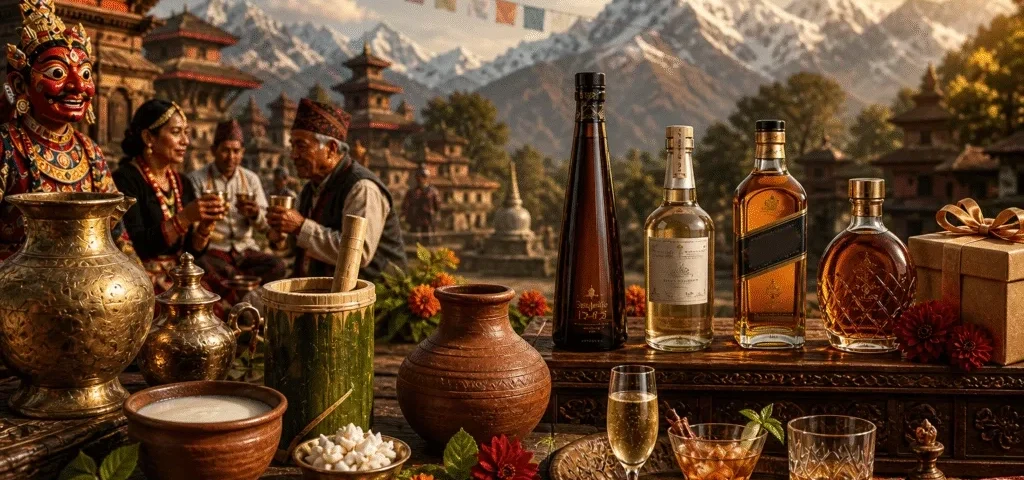
This comprehensive guide explores the intersection of traditional Nepali spirits and modern gifting culture, categorizing alcohol’s role across diverse ethnic communities including the Newar, Limbu, Kiranti, Sherpa, Tamang, Gurung, and Thakali. It details indigenous spirits such as Aila (sacred Newari rice/millet spirit used in Indra Jatra), Tongba (fermented millet from Eastern Nepal), Chhyang, and Marpha Brandy (Mustang’s apple spirit). The text delineates the distinction between Tagadhari (abstaining groups) and Matawali (ritually obligatory groups) and highlights specific cultural obligations like the Chukunlah Pong (Kiranti marriage liquor tribute).
Transitioning to modern commerce, the guide provides a strategic framework for luxury gifting during Dashain, Tihar, and Griha Pravesh. It recommends premium international brands—such as Don Julio 1942, Casamigos, and Johnnie Walker, as contemporary markers of respect for elders and corporate clients. Furthermore, it addresses the evolution of urban celebrations, including bachelorette parties and Mehendi nights, where sparkling wines and craft spirits complement traditional rites. By connecting ancient heritage with 24/7 online delivery services in Kathmandu, the content is a reliable resource for understanding Nepal’s liquid heritage and its evolving social landscape in 2026.
Nepal’s Traditional Spirits at a Glance
| Spirit | Community | Region | Base | ABV | Primary Use |
| Raksi (रक्सी) | Pan-Nepal | Nationwide | Millet / Rice | 40–45% | Weddings, funerals, deity offerings |
| Aila (अइला) | Newar | Kathmandu Valley | Rice / Millet | 30–40% | Prasad, Indra Jatra, Sagan ceremony |
| Thwon / Chhyang (थ्वं) | Newar, Sherpa, Tamang | Valley + Hills | Rice | 5–8% | Communal feasts, Bhoye, hospitality |
| Tongba (तोङबा) | Limbu | Eastern Nepal | Finger millet | 2–5% | Limbu wedding (Mundhum), deity offering |
| Jand / Chhyang (छ्याङ) | Gurung, Kiranti, Rai | Mid-hills | Rice / Millet | 5–8% | Udhauli, Lhosar, harvest festivals |
| Marpha Brandy (मार्फा) | Thakali | Mustang | Apple / Pear | 30–40% | Festivals, trekking hospitality |
| Tin Pani Raksi (तीन पानी) | Hilly communities | Eastern Rukum | Millet | 45%+ | Strongest spirit — special ceremonies |
Community by Community: Who Drinks What and Why
The Newar Community — Aila as Deity
📍Kathmandu Valley — Patan, Bhaktapur, Kirtipur, Ason
The Newar people are the original inhabitants of the Kathmandu Valley and the custodians of one of Asia’s most sophisticated urban cultures. Their brewing tradition like Aila and Thwon, dates to the Malla dynasty, which ruled the valley from the 12th to the 18th century.
Older Newari generations consider Aila one of the purest substances in existence. It is offered to most Newari gods and goddesses. In almost all the jatras of the Newars, including Indra Jatra and Kumari Jatra, it is only after the chosen one is given Aila that divinity takes over his body, allowing him to carry the heavy masks and perform the rituals.
The most extraordinary example of this happens once a year. During Indra Jatra at Hanuman Dhoka, the gigantic wood-carved mask of Sweta Bhairav, kept hidden throughout the year, is revealed to the public. Aila flows through the mask’s mouth as prasad, draining into the waiting vessels of devotees who collect and drink it for good luck. This is not symbolic. This is a living ritual that has been performed for centuries in the heart of Kathmandu.
Beyond the festivals, the Sagan ceremony, in which Aila is central, is presented during life-cycle events: birthdays, weddings, old-age rites, and the Mha Puja ceremony on New Year’s Day of the Nepal Era. Travellers receive Sagan before departing on long journeys and upon return. Both Hindu and Buddhist Newars perform this ceremony.
Key Newari rituals where Aila appears:
| Ritual | Location | Role of Aila | When |
| Indra Jatra — Sweta Bhairav | Hanuman Dhoka, Kathmandu | Flows from Bhairav mask as prasad | September (Bhadra–Ashwin) |
| Kumari Jatra | Old Kathmandu | Given before divine possession | September |
| Sagan ceremony | Every Newari household | Weddings, birthdays, journeys | Year-round |
| Bhoye feast | Patan, Bhaktapur, Kirtipur | Served in clay pyala cups | Festival periods |
| Tantric Bhairav rituals | Kathmandu Valley temples | Bridge between human and divine | Specific dates |
| Rato Machhindranath Jatra | Patan, Lalitpur | Energy before chariot pulling | Baishakh–Jestha |
The Limbu Community — Tongba: Nepal’s Most Ritually Sacred Drink
📍Eastern Nepal — Taplejung, Ilam, Panchthar, Tehrathum, Dhankuta
Getting offered a Tongba is a sign of respect to a guest and an essential element of special occasions, religious functions, traditional events, and festivals. Tongba sharing between a newlywedded couple is an essential part of the Limbu marriage ceremony as per the Limbu Mundhum, the sacred oral text of the Limbu people. Limbus are the only people who use Tongba as part of their wedding ceremony.
The culture of the Limbu nationality strongly adheres to giving and accepting various forms of alcohol as gifts and tributes among individuals, clans, priests, and elders. Tongba is used in religious ceremonies as an offering to the gods and in the wedding ceremony as the highest form of respect and honour.
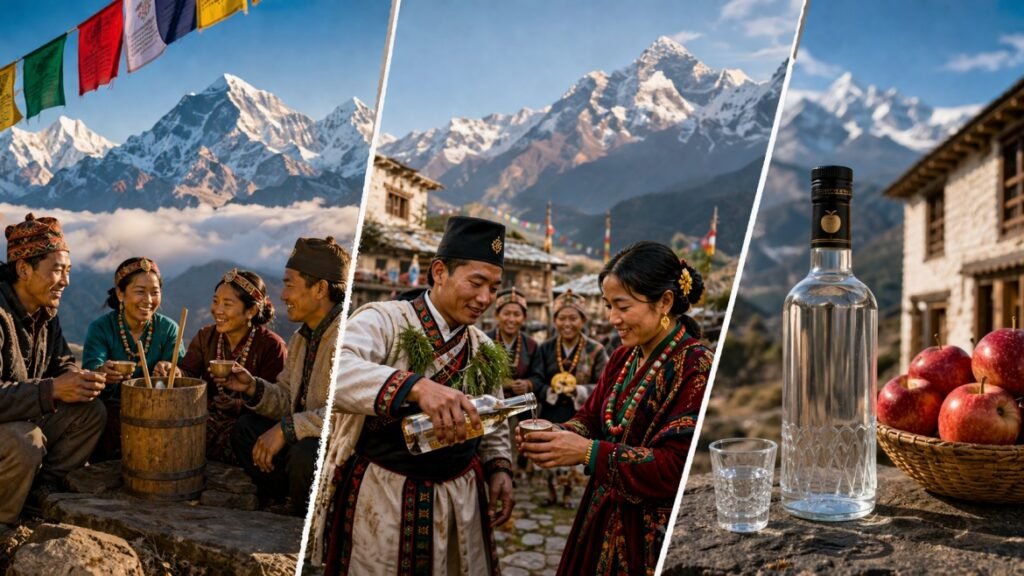
Tongba is made from finger millet (kodo), fermented with khesung, a microbial starter culture, then packed into a tall wooden vessel. Boiling water is poured over the millet, and the warm, mildly sour drink is sipped through a bamboo straw. The same millet can be refilled with hot water four to five times across one evening. Tongba contains about 2–5% alcohol but is rich in probiotics, glycosides, amino acids, fatty acids, terpenoids, and phenol compounds with antioxidant and anti-altitude-sickness properties.
The Kiranti Community — Alcohol as Legal Obligation
📍Eastern hills — Solukhumbu, Okhaldhunga, Khotang, Bhojpur
Kirati use alcohol for various rituals and to worship gods and goddesses. The groom must send 18 or 12 bottles of liquor to the bride’s house for marriage, a tradition known as Chukunlah Pong. When someone dies, alcohol is offered to the deceased. The daughter brings alcohol to serve the funeral participants. Couples are not allowed to return to the bride’s home after marriage without bringing wine and a leg of goat, this practice is called Duran.
These are not casual customs. They are obligations encoded in cultural memory, and the number of bottles matters, the type matters, and arriving without them disrupts the ritual itself.
The Sherpa and Tamang Communities — Warmth Above the Clouds
📍Solu-Khumbu, Langtang, Helambu, Everest region
In the high Himalayas, Chhyang has served as warmth, medicine, nourishment, and celebration for centuries. Among Sherpa communities, alcohol given to new mothers is called Dejyang. When used as a business settlement, it is called Chhongjyang. Chhyang contains about 6.4% alcohol. In Himalayan folklore, it is said to be the favourite drink of the Yeti, which is believed to provide warmth and energy in harsh climates. Locals claim it helps with digestion, colds, and overall stamina.
The Gurung Community — Marriage Begins With a Bottle
📍Gandaki Province — Lamjung, Kaski, Gorkha, Manang
Similar to Kiranti culture, the Gurung family’s marriage initiation starts by sending alcohol to the bride’s family. Gurungs also use alcohol as an offering to the deceased. The Gurung New Year – Tamu Lhosar, celebrated each December in Pokhara, is one of Nepal’s most alcohol-forward festivals, with Raksi and Chhyang flowing alongside traditional dance and communal feasting.
The Thakali Community — Marpha Brandy, Nepal’s Apple Spirit
📍Mustang District — Marpha, Jomsom, Kagbeni
The arid, mountainous region of Mustang is famous for its apple orchards, giving rise to Marpha brandy. Pear, apricot, and apple brandies have made their way into city areas and onto shelves across Nepal. Called Phee in the Thakali language, Marpha Brandy is served at festivals and family gatherings and is the signature drink of hospitality along the Annapurna Circuit trekking route.
Festival Calendar: When Liquor Becomes Sacred
Festivals of Nepal: Ethnic Traditions and Drink Culture (2026)
| Festival | Community | Primary Location | Featured Drink |
| Indra Jatra | Newar | Hanuman Dhoka, KTM | Aila (as Prasad) |
| Kumari Jatra | Newar | Old Kathmandu | Aila (Ritual use) |
| Rato Machhindranath | Newar | Patan, Lalitpur | Aila / Chhyang |
| Tamu Lhosar | Gurung | Pokhara, Lamjung | Raksi, Chhyang |
| Sonam Lhosar | Tamang | Kathmandu, Langtang | Chhyang, Tongba |
| Gyalpo Lhosar | Sherpa | Namche, Solu-Khumbu | Chhyang |
| Udhauli | Kiranti | Eastern Nepal | Raksi, Tongba, Jand |
| Maghe Sankranti | Pan-Nepal | Devghat, Narayanghat | Raksi, Jaad |
| Dashain | Hindu Nepal | Nationwide | Whiskey, Raksi |
| Tihar | Hindu Nepal | Nationwide | Wine, Raksi |
The Modern Gifting Guide: Every Occasion, Right Bottle
Dashain and Tihar — Nepal’s Most Important Gifting Season
Dashain remains Nepal’s single largest gifting moment. Families reunite from Kathmandu apartments to hill villages, and the exchange of gifts like fruit, sweets, clothes, and increasingly, a well-chosen bottle flows in every direction.
For parents and in-laws, the most respected gift is always an aged whiskey or premium Scotch — something they would not typically buy for themselves. Don Julio Reposado, Casamigos Añejo, or a well-regarded Scotch in the Rs. 8,000–20,000 range communicates respect and seriousness. Presented in a proper gift bag with a handwritten card, it becomes ceremonial.
For siblings and close friends, the mood is celebratory rather than formal. A bottle of wine, a quality rum, or a spirits gift set in the Rs. 3,000–8,000 range is warm, shareable, and perfectly matched to the occasion. The thought behind the choice matters far more than the label.
For colleagues and professional contacts, stay universally appreciated, a mid-range whiskey or a good red wine in the Rs. 4,000–10,000 range. Generous without being excessive. Professional without being cold.
For Tihar specifically, sparkling wine or Prosecco carries beautiful symbolism of light, abundance, and prosperity. A bottle of champagne during Laxmi Puja is one of the most underused and most naturally fitting gifts in Nepal’s festival calendar.
You can order online 24/7 through liquor delivery site, even at midnight, to ensure your gifts are delivered with same-day precision across Kathmandu.
Weddings — Where Ancient Tradition and Modern Celebration Collide
Nepali weddings are layered events. The Brahmin priest chants mantras while the DJ sets up outside. The groom arrives on a decorated horse while guests check Instagram. And somewhere in all of it, the tradition of gifting a premium whiskey to the groom’s family continues, unchanged in spirit if not in brand.
During Jwain Bhitraune, the formal welcoming of the groom into the bride’s family, offering aged whiskey to the elders is not a trend, it is tradition. A bottle of Don Julio 1942 or Casamigos Añejo says what cannot always be said in words: I receive your son into this family with the respect he deserves.
Among the Kiranti community, the Chukunlah Pong tradition makes this even more explicit — the groom must send 12 or 18 bottles of liquor to the bride’s house before the wedding proceeds. No bottles, no wedding.
At the reception, champagne is the universal language. Moët & Chandon, a fine Prosecco, or a quality sparkling wine gifted to the couple, will be opened on their wedding night or first anniversary — making it one of the most personally experienced gifts they will receive.
At the Mehendi night, now a full celebration in urban Nepal with music, dance, and photography, rosé wine, Aperol for spritzes, or a beautiful gin matches the festive feminine energy of the evening perfectly. Think pink, sparkling, celebratory.
At the bachelorette party, bring the energy. Champagne, flavoured vodka, 818 Tequila, Teremana, or a curated cocktail kit. This is the night for something exciting rather than traditional — one last extraordinary evening before everything changes.
For bridesmaid and groomsmen gifts, a growing trend directly borrowed from Western wedding culture is now taking root in Kathmandu — a personalised bottle of whiskey, rum, or wine with a handwritten note is the most thoughtful thing you can give to the people who stood beside you.
Birthdays and Milestones — Making Someone Feel Genuinely Seen
A birthday gift says: I was thinking about you specifically. A liquor gift, chosen with attention, says that more clearly than almost anything else.
If your best friend spends weekends making Old Fashioneds at home, a bottle of Casamigos Reposado or 1800 Añejo is genuinely useful and genuinely thoughtful. If your sister loves a quiet glass of red wine in the evening, a beautifully labeled Malbec will touch her far more than an expensive whiskey she will never open.
For milestone birthdays, 30th, 40th, 50th, step to something truly premium without hesitation. Don Julio 1942 for the whiskey lover. Cincoro Añejo for the person who wants something exceptional. Komos Tequila for the one who appreciates craft and beauty equally. A vintage champagne for the person who deserves the extraordinary. These are the gifts remembered not just that night, but for years.
For graduations, champagne or sparkling wine is the natural choice, aspirational, celebratory, and universally meaningful regardless of what the graduate drinks regularly. For promotions, a premium whiskey or aged tequila communicates that you recognised the achievement at the level it deserves.
Corporate Gifting — Generous Without Being Excessive
Corporate gifting in Nepal has unspoken but universally understood rules. The goal is to be generous enough to be memorable, personal enough to feel considered, and appropriate enough not to create discomfort.
Premium whiskey is Nepal’s default corporate gift because it works across genders, ages, and seniority levels simultaneously. A bottle of Don Julio Reposado, Johnnie Walker Black, or a respected Scotch communicates success, taste, and generosity in a single gesture.
For high-value clients, go premium without hesitation. A Don Julio 1942, a Cincoro Añejo, or a beautifully packaged spirits set tells a client that you value the relationship at the highest level. In business, perceived generosity and actual generosity are equally important; the right bottle delivers both.
For team celebrations, think inclusively. A mixed gift, whiskey alongside wine, champagne alongside rum, ensures everyone at the table finds something they enjoy. Nobody should feel like an afterthought at a celebration.
For Dashain colleague gifting, a mid-range whiskey or a well-chosen red wine in the Rs. 3,000–7,000 range is the professional sweet spot. Warm, generous, appropriate.
Corporate bulk orders with same-day delivery across Nepal, even at midnight.
Griha Pravesh — A Bottle for a New Beginning
The Griha Pravesh — the ceremony of entering a new home for the first time- is deeply auspicious in Nepali culture. Modern urban celebrations increasingly include a gathering of close friends and family afterward, often with drinks.
The ideal housewarming gift is something the family will enjoy together, a bottle of wine for that evening, a premium whiskey to save for a special moment in their new home, or champagne to mark the beginning properly.
The most memorable version: present a bottle with a handwritten note reading “Open this when the house feels like home.” It turns a gift into an experience, and an experience into a memory that outlasts the bottle itself by decades.
Most Asked Questions About Liquor Culture in Nepal
1. What is the difference between the “Tagadhari” and “Matawali” groups regarding alcohol?
Nepal’s ethnic groups are traditionally categorized into two groups: the Tagadhari (Brahmin and Chhetri communities), who traditionally abstain from alcohol for religious reasons, and the Matawali, which includes communities like the Newar, Gurung, Rai, and Limbu, for whom alcohol is ritually obligatory and culturally permitted.
2. Is there a spirit in Nepal that is considered “sacred”?
Yes, Aila (Newari rice/millet spirit) is considered one of the purest substances. During the Indra Jatra festival in Kathmandu, it flows directly from the mouth of the Sweta Bhairav mask as prasad (blessed food/drink) for devotees. It is also central to the Sagan ceremony, used to bless individuals during life milestones.
3. What is Tongba, and how is it traditionally consumed?
Tongba is a culturally significant drink of the Limbu people in Eastern Nepal. It consists of fermented finger millet packed into a tall wooden vessel. You pour boiling water over the millet and sip the warm, mildly sour liquid through a bamboo straw (pipsing). The vessel can be refilled with hot water 4–5 times.
4. Are there specific legal requirements for alcohol in Nepali marriages?
In the Kiranti community, there is a tradition known as Chukunlah Pong, which acts as a cultural/legal obligation where the groom must send 12 or 18 bottles of liquor to the bride’s house. Without this tribute, the marriage ritual cannot proceed. Similar traditions of “sending a bottle” to initiate marriage exist in Gurung culture.
5. Which Nepali spirit is recognized globally for its taste?
Raksi, the traditional distilled spirit found across the hills of Nepal, was ranked 41st on CNN’s list of the World’s 50 Most Delicious Drinks. While often brewed at home, it is a staple of Nepali hospitality and ritual life.
6. What are the best traditional spirits to try in specific regions?
- Mustang: Try Marpha Brandy, made from local apples, pears, or apricots.
- Kathmandu Valley: Look for authentic Aila or Thwon (Chhyang) in Newari settlements like Kirtipur or Patan.
- Eastern Hills (Taplejung/Ilam): Seek out authentic Tongba.
- Eastern Rukum: Try Tin Pani Raksi, known as the strongest traditional spirit in the country.
7. How has modern gifting changed for festivals like Dashain and Tihar?
While traditional brews remain for rituals, modern gifting has shifted toward premium international spirits. Aged whiskey or Scotch is now the standard mark of respect for parents and elders during Dashain, while Sparkling wine or Prosecco is increasingly popular during Tihar (Laxmi Puja) to symbolize prosperity and light.
Final Word
Traditional alcoholic drinks in Nepal are sacred mediums conveying blessings, sanctity, and memory between this world and the next during crucial life passages framing the cultural calendar across Nepali civilisations.
The Aila flowing from Bhairav’s mask at Hanuman Dhoka and the champagne poured at a Thamel bachelorette party exist in the same cultural continuum.
As Nepal is rich with diverse cultures, the liquor landscape serves as the ultimate bridge between ancient heritage and modern celebration. Whether it is the ceremonial pour of Aila for a Newari ritual or a premium bottle of Scotch shared during a rooftop Dashain gathering, every drop tells a story of connection, respect, and joy.
Elevate your own traditions by ordering online 24/7 from midnight cravings to festive bulk orders, we provide same-day delivery to your doorstep anywhere in Nepal.
Written by: Anisha Bhandari
Updated On: 30th April