
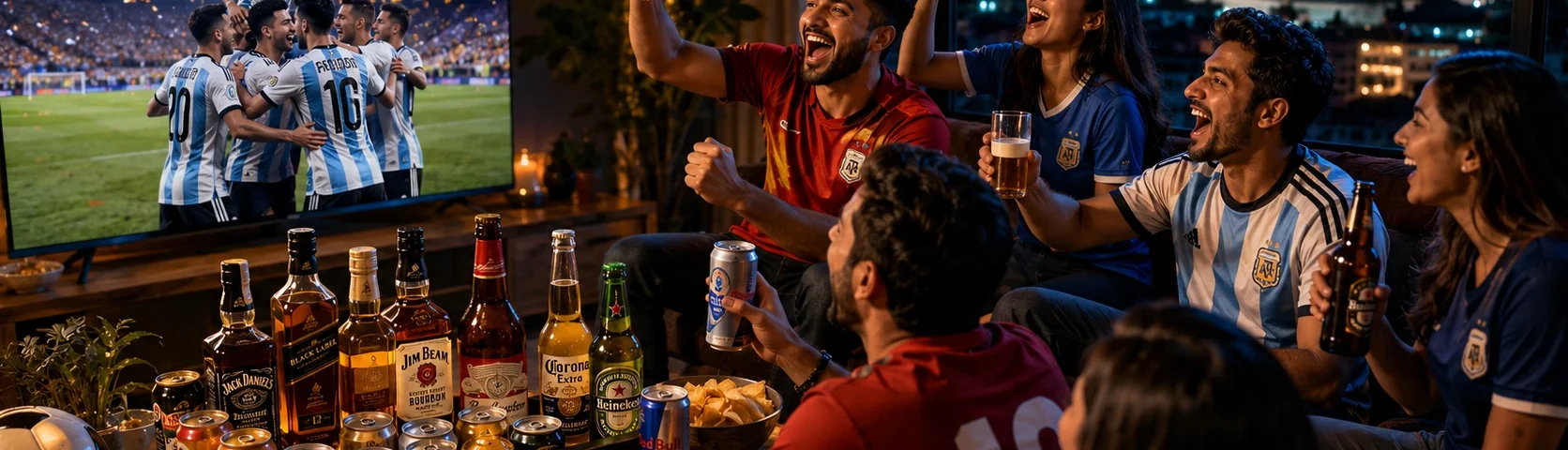
The FIFA World Cup 2026 is the largest sporting event in human history by almost every measure — 48 nations, 104 matches, 16 host cities, and an estimated 5.8 to 6 billion global viewers. For football fans in Kathmandu, it means 39 nights of matches starting at midnight, living rooms as the main venue, and a global drinks industry spending more than it ever has on any single sporting event. Following Qatar 2022’s controversial last-minute stadium alcohol ban, the 2026 tournament in the commercially permissive markets of the USA, Canada, and Mexico marks a historic reversal.
Giant conglomerates like AB InBev and Diageo are investing billions, introducing unprecedented partnerships featuring brands like Michelob Ultra, Johnnie Walker, and Don Julio. Simultaneously, Nepal’s drinking culture is rapidly premiumizing, with alcohol consumption rising over 50% in the last decade. Because Nepal Standard Time positions most kickoffs between 12:45 AM and 9:45 AM—well after local bars close—home viewing is the primary tournament reality. Consequently, hyper-local on-demand logistics providers, like Darumandu’s 24/7 midnight delivery service in Kathmandu, have become essential infrastructure, bridging the gap between aggressive global sports marketing and the practical consumption realities of international fans.
The FIFA World Cup 2026 is the largest sporting event in human history by almost every measure: 48 nations, 104 matches, 16 host cities, and an estimated 5.8 to 6 billion global viewers. For football fans in Kathmandu, it means 39 nights of matches starting at midnight, living rooms as the main venue, and a global drinks industry spending more than it ever has on any single sporting event.
Qatar 2022 — The World Cup That Banned Alcohol (And Why 2026 Is the Full Reversal)
What Actually Happened at the 2022 Qatar World Cup
The 2022 FIFA World Cup in Qatar became the most controversial alcohol story in football history, not because of a long-planned ban, but because of a last-minute reversal that shocked the global drinks industry.
Two days before the tournament began, FIFA and Qatari authorities announced that alcoholic beer would no longer be sold to regular fans at or around the eight World Cup stadiums. The decision, made 48 hours before the opening match, left Budweiser, the official beer sponsor, with massive unsold inventory and a ruined campaign strategy.
What was banned at Qatar 2022:
- Alcoholic beer sales for regular spectators at all eight World Cup stadiums
- Alcohol in the ticketed perimeter areas around the venues
- Public alcohol consumption in most of Qatar outside designated zones
What was still permitted:
- Non-alcoholic Bud Zero, which remained available inside stadiums
- Alcohol in licensed hotels, restaurants, and designated fan zones
- Alcohol in premium VIP and hospitality suites inside stadiums
- Consumption in private settings
The ban was a sharp collision between FIFA’s decade-long commercial relationship with global beer brands and Qatar’s Islamic cultural context. Qatar, as an Islamic nation, has strict restrictions on alcohol in public life; it was never going to be a free-drinking tournament. But the last-minute reversal, after months of promises that alcohol zones would be established near stadiums, was a public-relations disaster.
Budweiser’s response became one of the most-shared brand moments of the tournament. After the ban was announced, Budweiser tweeted, “Well, this is awkward”, a line that captured the global mood perfectly. The company later auctioned the unsold Qatar stock to the winning nation of the tournament.
Why This Matters for World Cup 2026
The Qatar experience had three lasting consequences for World Cup 2026:
First, it proved that the global drinks industry would fight harder than ever to reclaim the World Cup as an alcohol-forward event. Every major brand saw the Qatar ban as both a financial loss and a brand visibility disaster.
Second, the choice of the United States, Canada, and Mexico as the 2026 World Cup organizing countries guaranteed a cultural environment where alcohol and live sports are deeply intertwined. The NFL, NBA, and MLB have built alcohol sponsorship into their core business model. FIFA bringing the World Cup to North America was, in part, a return to commercially permissive territory.
Third, Anheuser-Busch InBev and Diageo, the two largest alcohol conglomerates in the world, used the Qatar reversal as justification for the largest sports alcohol sponsorship deals in history. The message: never again.
FIFA World Cup 2026 Organizing Countries and Host Cities
The Three-Nation Format — A First in World Cup History
The FIFA World Cup 2026 is hosted jointly by three countries: the United States, Canada, and Mexico. This is the first time in World Cup history that three nations have co-hosted the tournament — and it gives the event a geographic scale that no previous World Cup has matched.
The United States carries the largest share, with 11 host cities. Canada hosts in two cities, and Mexico hosts in three. Together, the 16 host cities span thousands of miles across North America, from Vancouver on the Pacific to Boston and Miami on the Atlantic coast.
Complete List of World Cup 2026 Host Cities
United States (11 cities):
- New York / New Jersey (MetLife Stadium)
- Los Angeles (SoFi Stadium)
- Dallas (AT&T Stadium)
- San Francisco Bay Area (Levi’s Stadium)
- Miami (Hard Rock Stadium)
- Atlanta (Mercedes-Benz Stadium)
- Seattle (Lumen Field)
- Boston (Gillette Stadium)
- Kansas City (Arrowhead Stadium)
- Philadelphia (Lincoln Financial Field)
- Houston (NRG Stadium)
Canada (2 cities):
- Toronto (BMO Field)
- Vancouver (BC Place)
Mexico (3 cities):
- Mexico City (Estadio Azteca)
- Guadalajara (Estadio Akron)
- Monterrey (Estadio BBVA)
The opening match takes place at MetLife Stadium in New Jersey. The final is scheduled for MetLife Stadium on July 19, 2026.
Why the Host Country Choice Changes Everything for Drinks
The United States, Canada, and Mexico are three of the largest alcohol markets in the world. Each has a distinct drinking culture that aligns closely with football fandom. In the US, stadium alcohol sales are standard practice across all major sports. In Mexico, beer sponsorship is woven into football culture at every level. In Canada, craft beer and spirits culture has grown significantly over the past decade.
For international viewers in Kathmandu, the host-country context matters because it shapes the brands you will see most prominently: Michelob Ultra, Bud Light, Corona, Don Julio, and Johnnie Walker are all deeply embedded in North American sports culture and are now the official faces of World Cup 2026.
The Global Drinks Industry’s Biggest World Cup Bet
The Alcohol Industry’s Comeback Play
The global beer industry has been fighting a decade-long structural decline. Consumption fell 3% worldwide between 2014 and 2024, and in the United States, beer consumption declined by 17% over the same period. The rise of hard seltzers, canned cocktails, and health-conscious drinking habits has fundamentally restructured the market.
The FIFA World Cup 2026, projecting 5.8 to 6 billion global viewers across 39 days, represents the largest single recovery opportunity the alcohol industry has had in a generation. The brands are spending accordingly.
The Official Sponsors: What They Are Spending
Anheuser-Busch InBev (Michelob Ultra) AB InBev is investing over $110 million in FIFA sponsorships and advertising for World Cup 2026, making Michelob Ultra the Official Beer of FIFA World Cup 2026. The campaign stars Lionel Messi, Christian Pulisic, and Billy Bob Thornton in what is being called one of the most expensive beer commercials ever produced. This is a significant strategic shift — Budweiser was the previous official beer brand, but AB InBev pivoted to the premium Michelob Ultra positioning to chase the health-conscious consumer who still drinks.
Diageo (Don Julio, Casamigos, Buchanan’s, Johnnie Walker, Smirnoff) Diageo made history by becoming the first-ever Official Spirits Partner of a FIFA World Cup. This is genuinely unprecedented — FIFA had never had an official spirits partner before 2026. Diageo is activating five of its flagship brands across all 16 host cities: Don Julio (tequila), Casamigos (tequila), Buchanan’s (Scotch whisky), Johnnie Walker (Scotch whisky), and Smirnoff (vodka).
Molson Coors Even without official FIFA rights, Molson Coors is spending 60% more on advertising around the World Cup than it has on any live sporting event in the past decade. Competition for alcohol visibility at a 6-billion-viewer tournament does not require official sponsorship to justify the investment.
FIFA’s Total Sponsorship Revenue: FIFA’s total sponsorship revenue for the World Cup 2026 is expected to exceed $2.8 billion — more than double the Qatar 2022 figure. The reversal from Qatar’s alcohol restrictions to North America’s commercially permissive environment is the primary driver of this growth.
The World Cup 2026 Official Bottles Worth Ordering in Kathmandu
Don Julio 1942 FIFA World Cup 2026 Limited Edition Don Julio is an Official FIFA World Cup 2026 sponsor under Diageo’s historic spirits partnership. The 1942 expression is aged in American white-oak barrels with notes of vanilla, caramel, and toasted oak. Released in exclusive World Cup packaging, this is the collector bottle of the tournament. Order on Darumandu and save it for the semifinals or final.
Buchanan’s FIFA World Cup 2026 Edition The official Scotch of the World Cup under Diageo’s partnership. The Deluxe 12-Year Old and the Pineapple Blended Scotch — branded “EL GOLAZO, LA FIESTA” — are the two flagship releases. Buchanan’s has deep cultural roots in Latin American football celebration culture, making it one of the most authentic pairings of 2026.
Casamigos Co-founded by George Clooney, Casamigos is an Official World Cup 2026 sponsor covering tequila across all host cities. Widely available on Darumandu as one of the premium tequila options for match nights.
Johnnie Walker The global Scotch flagship under Diageo’s sponsorship. Johnnie Walker Red Label and Black Label are the accessible daily-drinking options; the 18-Year and Blue Label are the celebration pours for knockout stages.
Smirnoff The Official World Cup Vodka under Diageo. Smirnoff vodka lime soda is the standard late-night alert drink for the 12:45 AM and 3:45 AM kickoff windows.
Kathmandu’s World Cup Reality — Midnight Matches and Home Celebrations
The Nepal Time Problem (And How to Work With It)
The FIFA World Cup 2026 is scheduled primarily for North American time zones, which means Kathmandu, operating on Nepal Standard Time (UTC+5:45), faces some of the most extreme viewing hours of any major football market in the world.
Most matches kick off between 12:45 AM and 7:45 AM Nepal time. The excitement is already building across the city. Burger House, one of Kathmandu’s popular sports-viewing destinations, expects a 30–40% customer surge during World Cup 2026. Beer consumption at Trisara Restaurant climbed 40% in the year leading up to the tournament.
But the practical reality is that most Kathmandu bars close between 10 PM and 11 PM. The midnight and early-morning kickoff windows mean the real celebration happens at home, which is where Darumandu’s midnight delivery model becomes essential.
Your Match-Time Drink Strategy by Kickoff Window
12:45 AM — The Main Slot The most common kickoff time for Nepal fans. You need something that keeps you alert through 90 minutes and potential extra time. The best choices: whiskey with soda (Johnnie Walker Red or Black — the Official World Cup Scotch), dark rum and cola (Old Monk or Bacardi), or vodka lime soda (Smirnoff — Official World Cup Vodka). Avoid heavy pours at this hour.
3:45 AM — The Deep Night Window The hardest slot in the schedule. You are deep into the night, and anything heavy will knock you out before the final whistle. Cold lager (Tuborg or Carlsberg), gin and tonic, or a ready-to-drink (RTD) canned cocktail are the right calls. Light, cold, and easy. Order the evening before, not at midnight.
6:45 AM and 9:45 AM — Early Morning Kickoffs These are the easiest viewing windows. You wake up, pour something, and it feels celebratory rather than an endurance test. A Bloody Mary, a mimosa with sparkling wine, or cold lager with breakfast food is the right move. If your team is in the knockout stages at this hour, something cold and sparkling is fully justified. Pre-order the night before on Darumandu.
Drink Like the Country You Are Cheering For
The World Cup 2026 has 48 nations across six confederations. Part of the celebration is drinking like the culture you are supporting. Here is the complete guide organized by team:
| Team | Traditional Drink | What to Order |
| Argentina | Fernet con Coca or Malbec | Dark rum + cola as substitute |
| Brazil | Caipirinha (cachaça-based) | White rum, lime, sugar, ice |
| Mexico | Tequila — Paloma or reposado neat | Don Julio or Casamigos |
| England | Scotch whisky or real ale | Johnnie Walker Black Label |
| France | Cognac or red Bordeaux | Hennessy or Martell |
| Germany | Cold lager — Pilsner style | Tuborg or Carlsberg |
| Spain | Red Rioja or Cava sparkling | Full-bodied red wine |
| Portugal | Port wine or aged Douro red | Full-bodied red wine |
| USA | Bourbon or craft IPA | Jack Daniel’s or Jim Beam |
| South Korea | Soju or light whisky | Light whisky or substitutes |
| Japan | Whisky highball | Light blended whisky + soda |
| Morocco | Mint tea (non-alcoholic) | Sparkling water, juices |
| Senegal | Bissap (hibiscus, non-alc) | Fruit juices or mocktails |
| Ecuador | Craft beer or aguardiente | Local beer or dark spirits |
| Australia | Cold lager | Tuborg or Carlsberg |
| Netherlands | Heineken-style cold lager | Carlsberg or cold pilsner |
Nepal’s Drinking Culture and the World Cup Moment
Nepal Is Already Drinking More, And Better
Nepal’s alcohol consumption grew 50% among men and 55% among women between 2013 and 2022. The country’s per capita consumption reached 1.5 litres by 2025 and continues to rise. Kathmandu’s market is actively shifting toward premium whiskey, vodka, gin, and cocktails — exactly the category the World Cup 2026 official brands are pushing.
The intersection of a rising premium spirits market in Nepal and the most commercially aggressive World Cup alcohol campaign in history creates a unique moment. The brands sponsoring the 2026 World Cup- Don Julio, Johnnie Walker, Casamigos, Smirnoff, Michelob Ultra— are available in Kathmandu and deliverable to your door through Darumandu.
You do not need to be in Los Angeles, Mexico City, or Toronto to drink like the world is drinking this summer.
Practical Ordering Rules
Order by 10 PM for midnight delivery. Pre-order the day before for the 3:45 AM window, you do not want to be ordering at 2 AM. For large-group match nights with 10 or more people, pre-order 24 hours in advance on Darumandu for guaranteed stock.
Save premium bottles — the Don Julio 1942, the Buchanan’s 12-Year, the Johnnie Walker Black Label for the quarterfinals and beyond. The group stage is for everyday bottles. The final deserves something worth remembering.
Pace Yourself Across 39 Nights
Drink one glass of water for every alcoholic drink during late-night matches, it keeps you alert and functional into the second half and extra time. Eat before the 1 AM sessions; drinking on an empty stomach at midnight is a fundamentally different and more punishing experience.
The best approach to a 39-day tournament is moderation by design: light during the group stage, more intentional in the knockouts, and reserved for the moments that matter. When Argentina scores in the 90th minute, when Brazil attacks in extra time, when your team reaches the final, those are the moments worth the premium bottle.
Order on Darumandu Before the Kickoff
The FIFA World Cup 2026 opens June 12 at 12:45 AM Nepal time. 104 matches. 39 nights. The three World Cup 2026 organizing countries — the United States, Canada, and Mexico — are hosting 48 nations across 16 cities. Every match is playing while Kathmandu sleeps, or tries to.
You do not need a bar to stay open past midnight. You need a midnight delivery service to enjoy this. Enjoy every goal with Darumandu.
Order. Delivered before kickoff. Every match night.
Author: Anisha Bhandari
Updated on: 8th June